Showing posts with label literacy. Show all posts

Monday, March 16, 2020

A "Typical" Day in the Life of a Homeschooling Family

Hey readers!

So I felt compelled to write this post to help out all the new homeschooling mamas (and dads), whether temporary or long-term, out there. With schools closing left and right, the prospect of being your child's teacher for the short-term (and perhaps long-term), can feel dizzying. Many of you were blessed with teachers who gave you a packet of paced-out assignments to do during the school shutdown and teachers that are working hard to provide quality distance learning! Honestly material gathering and pacing are THE hardest parts when first starting homeschooling, so you're in a GREAT place!

Looking at that packet could feel a bit intimidating. Maybe you've never had classroom teaching experience before, or maybe you had difficulties in school yourself and don't feel like you can do this.

Take a breath right now Mama, and repeat after me:

"I was my child's first teacher. I did it then. I CAN do it again!"


And it's completely true! You were there to offer those enriching read alouds when they were snuggled in their cozy PJs on your lap, to answer the late night questions about why the moon comes out at night, and to shriek in delight as they did their first puzzle all by themselves!

The challenge now becomes how to manage instruction time AND all the other items in the house. Now that we're in our 3rd year of homeschooling, I feel that we've hit a pretty good rhythm for our daily routine, and I wanted to share it with y'all to help ease your transition!

As a disclaimer, please note that this routine works best for my kiddos and my family. The beauty of homeschooling is that you can adjust your own routines so they work best for you! Feel free to use this as a jumping off point and tweaking it until it feels right for you!

For this schedule, kid activities will be noted in blue and "mom" activities will be noted in red.

Our Morning

Wake Up and Breakfast

  • Kids wake up, get dressed for the day, Charlotte switches the laundry from the washer to the dryer and starts it, and then the kids have screen-free, free play while waiting for breakfast. 
  • I dress and change the baby, empty the dishwasher from the night before, put on the coffee, and make breakfast.
  • Kids eat breakfast, clean up their spots, putting dishes in the dishwasher, and are free to play outside or inside, usually about 20 minutes.
  • I clean up the kitchen from breakfast, check my lesson plans, and lay out materials for the day at their places on the table.

Academics Round 1 (usually around 8:30)


  • Kids come over to the table for school. We start with our morning song, calendar time, and then each child has their first morning assignments.
    • Thompson, for PreK3, has a combination of his WB pages, phonics work, math, and activity binder. (He's usually done in 25 minutes).
    • Charlotte, for 1st grade, has her math workbook lesson (2-4 pages), sometimes a math worksheet for the day, and occasionally I give her part of the next lesson block if I know she'll work through quickly. (She's usually done in 20-25 minutes).
  • After teaching, I put the materials away and check what I need to, giving feedback. I then look up materials Charlotte will need for her next academic time and put them aside.

Free Play Time

  • Kids either go outside to play or play inside (we are still doing screen-free play).
  • I usually take a short 10 minute break and decompress with coffee. Then, if we need to run errands or go to practice, this is the time that is done. Also, we might get exercise in by running/biking to the park before it gets too hot or going on a walk.

Academics Round 2 (this can either happen in 2 pieces right before lunch and then during little kid nap, or only during nap time depending on the length of the lessons)


  • Charlotte comes to the table to do a combination of lessons that can require more guided instruction. She will do:
    • instructional reading for comprehension, 
    • phonics work,
    • spelling,
    • and social studies, geography, or science (depending on the day)
  • Whether we do this all at once or break it up, the combined time is usually between 40-50 minutes.
  • I usually let Josie and Thompson play during this time, or I put on an instructional video for them to watch in the playroom (out of sight of Charlotte).
  • After lessons, I put the materials back, prep for Religion, and then start lunch.

Lunch and Religion


  • Kids eat lunch and then toward the end, we do our Religion Lesson for the day (usually 15-20 minutes). They then clean up their plates, put them in the dishwasher, and play about 10 minutes.
  • After Religion, I clean up the materials, clean up the kitchen, put Josie down for nap, and then get Thompson down for nap, and Charlotte for rest.
  • I'll tidy up a bit or do a couple items I need to get done (pay bills/write emails) for 15- 20 minutes before I get Charlotte to finish Academics Round 2

Nap for Littles/Academics Round 2 for Charlotte

  • If Charlotte finishes early, she can do quiet play (puzzles, coloring, etc.) with me while waiting for brother and sister to wake up.

Afternoon TV/Warm Up from Nap

  • Kids wake up from nap and are allowed to watch movies/shows on Disney Plus, Netflix, Amazon Prime, etc. They usually need time to "warm up for the afternoon." (We don't use screens until after most of school is done, because they tend to have a difficult time focusing or having a positive attitude in school if they watch something first).
  • I'll usually fold a load of laundry on the couch while they watch something and put it away.

Afternoon Free Play
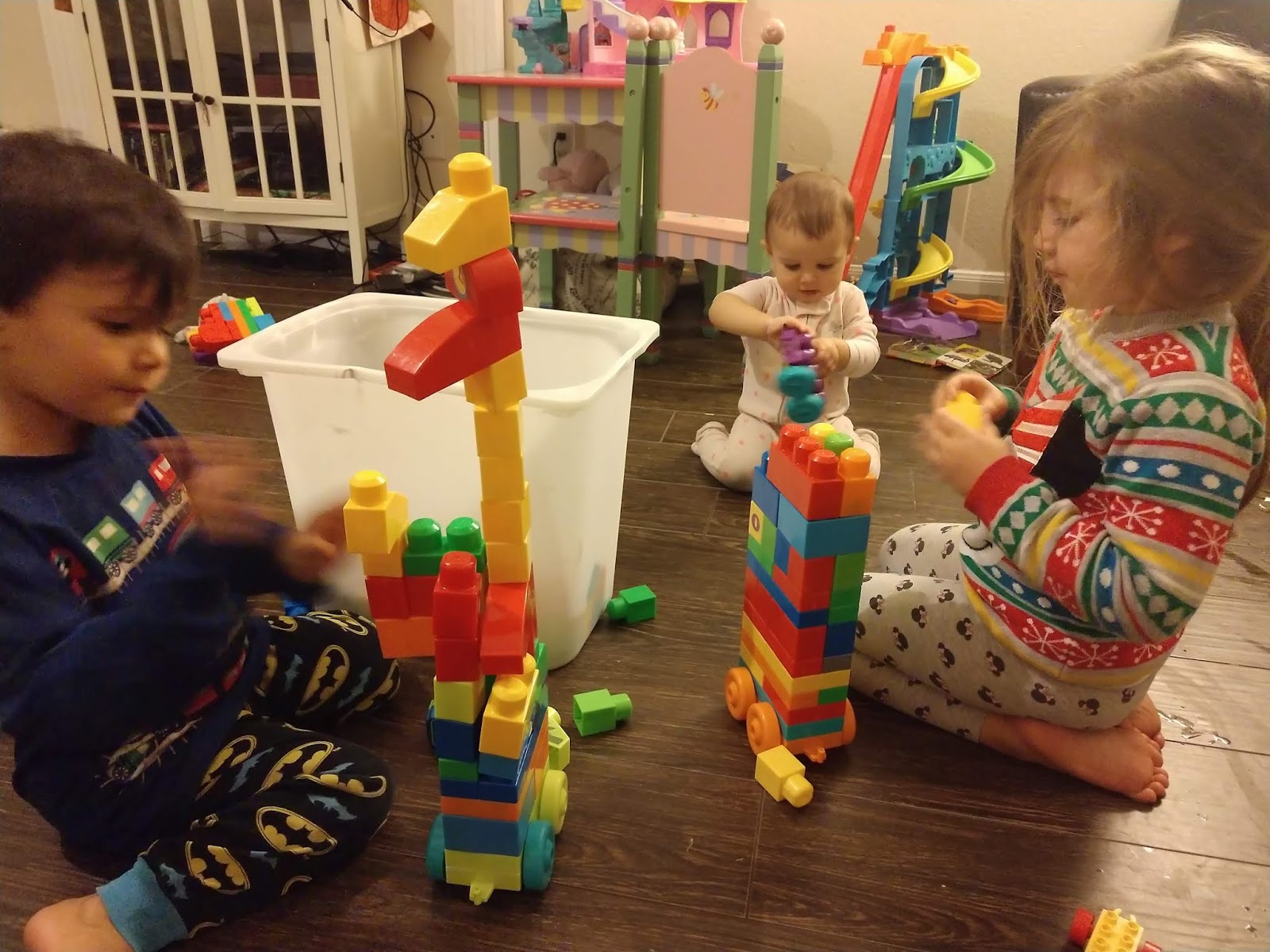

  • TV is turned off and kids have free play time.
  • Depending on time, I will check the dinner menu and start prepping.

Independent Reading Time

  • Later in the afternoon, Charlotte and Thompson will sit down with a pile of books and do their independent reading. I like to give them choice (hence the pile). Charlotte reads for 45 minutes and Thompson for 20-30.
  • If Thompson is particularly restless, I have him tidy up the living room or playroom while sister is reading once he has finished at least 20 minutes.
  • I keep my ear out for Charlotte as I cook dinner in the kitchen. If I have time, I might round up a load of laundry to put in for the night and help Thompson clean up.

Dinner

Evening Play/Winding Down/Writing
  • After dinner, kids will clean up their plates, and Thompson and Charlotte find something to play with.
  • I put Josie to sleep and clean up the kitchen.
  • Then, if Charlotte didn't do her writing during Academics round 2, I'll call her over to do it in the evening. She'll work on writing a letter or journal prompt response. (This usually takes 10-15 minutes).
  • After she's done, she gets dinner ready for the dog, and the kids can watch a little bit of TV before stories.
  • I'll use that time to tidy up a bit, get trash together, and then sit down with them to watch too.

Bedtime stories and Nighttime Routine

  • Kids pick stories for us to read together and then we go through nighttime routine.
  • After Thompson goes to bed, Charlotte and I will read 2-3 chapters from one of her favorite chapter books together, alternating pages to read aloud. Then, she'll go to bed too.

Quick Takeaways

  1. This is OUR schedule, but yours may look completely different based on your children, which again is the beauty of homeschooling!
  2. Some days will be awesome, some will be frustrating.
  3. On the frustrating days, take a break (which benefits both you and your child) and pick it up later in the day, or put it on the schedule for tomorrow.
  4. This is an exciting time for you to learn about your child, how they learn, and to spend extra time with them!
  5. Most importantly...YOU CAN DO THIS! You were your child's first teacher, and you can continue teaching now!
Happy teaching!


Friday, June 17, 2016

The Books I Buy for my Little Readers

Hello Readers,


Hopefully most of you are officially on your summer break! With the kids at home full-time and vacations starting to be planned, I imagine you've already made quite a few trips to the store (or Amazon) to pick up summer supplies. From swimsuits, to bug spray, suntan lotion, and brand new flip flops, summer vacation always seems shiny and new in June! Today, I'm writing to you to give some recommendations for some new summer books you might want to buy your itty bitties along with all of their other summer fun items! I get asked all the time, "Yeah, I know you use those books for your class, but what do you buy for your own daughter?" or "What series or books do you recommend for my PreK student to read?" Well, today you're in luck, because right before the end of the school year, I went on a big Scholastic Books shopping trip, and I bought a whole bunch of books for my daughter. Today, I'm going to tell you about 5 of my favorite books/series that I bought for her, why I like them, and how you can use them to help your little readers improve their reading skills this summer!

1. Clifford Books

Appropriate for: Ages 0-8


Why I like them

Clifford books are some of my favorites to use for a variety of reasons. First of all, who doesn't love a big red dog? In my experience, I've never met or taught a child who passed up the chance to read a Clifford book in this age range. The characters are wholesome, and there are a TON of books to choose from, so once you get your kid hooked, he will be occupied with the series for quite some time!

Now for more of the technical reasons, Clifford books offer a wealth of sight words! In fact, whenever I have a student within this age range that needs to develop their sight words, I will almost always reach for a Clifford book and start doing repeated readings on them. The plots within the books also offer opportunities to practice comprehension strategies such as making predictions, connections, working on retell, and questioning all of which are appropriate for this age range! The format of the books is also very predictable. For example, almost every books starts with "Hi, I'm Emily Elizabeth, and this is my dog Clifford." Although this might drive my more cynical parents nuts, this repetition is actually great for your little ones to develop their concepts of print and to start to "read the book" themselves. You will soon find, you'll start the first page for them, and they'll finish it, because they know what is going to be said. So in short...

How you can use them

*Work on sight words (and fluency through repeated readings)
*Have your kids practice comprehension strategies such as predictions, connections, retell, and questioning
*Strengthen concepts of print by pointing to words as they are being read within these predictable books

2. BOB Books

Appropriate for: Ages 0-8 (end of 2nd grade)

Why I like them

This series of books is truly an amazing one, because it offers leveled books from emergent readers (alphabet books and prereading skills) to more advanced decodable readers (books that focus on a certain word pattern or phonics skill) including long vowels and more complex word families. You buy the series in little sets, so as you see here, I bought a Rhyming Words set and Set 1 of the Beginning Readers. I really wanted the alphabet set for my 2 year old, but Scholastic was not selling them at this time, so I make sure to visit the library frequently to check them out for Charlotte. 

As a disclaimer, do NOT let the illustrations fool you. You may think that based on the cover and illustrations that you'd rather pass, but as mentioned the books that are in the set all offer excellent practice for the skill or level that the set suggests. For example, in this book Dan's Plan, (from the rhyming words set) the rhyming pattern is the -an family. Not only is this reinforced in the story, but on the last page, it highlights all of the -an words and other useful sight words. When Charlotte is ready to read this book, not only would I read the book with her, but we'd also use that last page to go over the -an pattern, and I could easily make flashcards to practice sight words with her based on the ones they suggest at the back. Between that helpful guide and repeated readings of the story, she'd quickly learn that pattern. Before she's ready to read it independently, however, I could read it to her, and ask her to listen for the rhyming words and tell me when she hears them. There's just SO much you can do with these books, and if you'd rather forgo the cost of buying all the sets, your local library most likely has them on the shelves!

How you can use them

*Alphabet recognition practice with the alphabet set
*Phonemic awareness (understanding the sounds in our language) practice with the rhyming set
*Sight word recognition and fluency (how smoothly your child reads the book aloud) by reading the books with your little ones
*Retell practice by having your little one tell you what the story was about

3. Frog on a Log?

Appropriate for: Ages 0-8 (end of 2nd grade)


Why I like it

Frog on a Log? is truly an adorable and playful book that really highlights rhyming words and patterns for our little readers. I got interested in this book, because it was highlighted at the Scholastic Book Fair this year, and I got the chance to preview it at that time. Throughout the book, the main character, the frog, is trying to find out why he has to sit on the log. The cat informs him that he himself has to sit on a mat, and then goes on to talk about other animals and the rhyming objects they have to sit on. Beyond the amusing and bright illustrations, this book is really great for beginning readers, because it allows them to expand their vocabulary and work on rhyming words, which is a vital skill for our littlest readers! While reading this book, you can easily have your child fill in the blank for you by saying which object an animal has to sit on. Because of the illustrations in the book, your little one that's JUST starting to work on rhyming words can easily find the rhyming object from the illustration, and as they get better, they will be able to fill in the blank without looking at the pictures. It's basically an example of a playful book where you can sneak in some valuable rhyming and vocabulary practice!

How you can use them

*Have your child practice rhyming words
*Increase your child's vocabulary (some of the objects in the story are not objects they would usually see)
*Have your child work on sequencing by having your child tell the order of animals and objects in the story. (Tell me which animal they mentioned first in the story. Okay, then what? Right! What did that animal sit on?)

4. If You Give a Mouse a Cookie Series

Appropriate for: Ages 0-8 (End of 2nd grade)


Why I like them

Between the adorable illustrations, the crazy events, and the lovable characters, this series really does have it all! For those of you unfamiliar with the series, basically the main character (a mouse, a cat, a pig, a dog, or a moose) is given something or taken somewhere and the rest of the story is a laughable chain of events that continue until the character is reminded of what he got in the first place and the reader is left to infer that all the events will continue happening over and over again. These books are EXCELLENT ones to use for both fluency and comprehension!

Fluency

These books are great for fluency practice, because the stories are motivating, so kids will want to read them again and again. Apart from that, each page has a limited amount of text, so it's easy for a parent and child to read every other page until the child feels confident enough to read the entire book himself. Additionally, the stories have many vital sight words in them along with words that commonly repeat within the story itself. So, by doing repeated readings, not only will they work on their first 100-200 sight words, but also, they will pick up novel words that repeat throughout the story.

Comprehension

As a reading specialist, I used many of these books within my Literacy Lab classes to help students work on a variety of comprehension strategies. My favorites to work on with these books included retell, making predictions, connections (text-to-self and text-to-text), inferences (specifically to infer character emotions), questioning, and cause and effect relationships. You can do all of these with these strategies within these stories, because the text is so brief. This means that it's up to the readers to use these strategies to expand the stories for themselves!

How you can use them

*Practice fluency skills by reading the series repeatedly and working on sight words within the story
*Practice comprehension skills such as retell, predictions, connections, inferences, questioning, and finding cause and effect relationships

5. Disney/High interest books

Appropriate for: ALL ages (it just depends on the difficulty of the books)


Why I like them

Sometimes as a parent, you really have to forgo the super-duper instructional books and just go with what your kid likes best! This is REALLY important for us to do, because even though we want to make sure we add in quality books to our children's reading, we have to also make sure our kids are enjoying what they're reading. The early years are so crucial for little ones to develop a love for reading, and what better way to do that than picking books for them that involve their deepest interest or their favorite characters! For Charlotte, she's REALLY into Finding Nemo, Mickey, and the Disney Princesses. This doesn't mean I have to get junky books with these characters, on the contrary, I made sure to buy a variety of different types of books that starred her favorite characters and also included some leveling. For example, I got her the Mickey Mouse beginning readers series, and Little Mermaid Reader (to work on fluency), a Palace Pets Search and Find book (for vocabulary development), a Finding Nemo song book (for fluency and phonemic awareness), and a Finding Nemo story book (mostly for fun!). It's important to remember that every book you get for your child does have some level of choice to it, and sometimes, it's absolutely fine for you to let them read books that aren't award winners, because they're actively developing their love of reading!


How you can use them

*Let you child pick a book with their favorite topic or characters and read it with them.
*Reread to work on fluency and talk about the book with your child to work on comprehension.


These 5 ideas should give you a great start for getting some really great high quality books for your little one to help them avoid the summer slide! Remember, as always, keep it fun! You want your little ones to not only have some extra quality reading practice, but also, and most importantly, some positive memories of reading with you which is what will really grow their own personal love of reading!

Until next time...

Yours in Literacy,

The Reading Specialista


Tuesday, April 12, 2016

You want to read that AGAIN??? Why rereading books is actually a good thing!

Hello Readers,


I know we've all been there before, and even I've been guilty of saying it, "You want to read that book again!?" Having fully memorized the sequence of animals that parade through Brown Bear, Brown Bear What do you See?, the exact costumes that appear in Minnie's Halloween Costume Contest, and all of the words in Duck and Goose Colors, I have to humbly admit, that my little girl clearly has her favorites. Even more, when she's on a favorite streak, we can read the SAME book 6-7 times in a row, and then 4-5 times more that same day. I'm here to offer all of those mommies, daddies, grandmas, and grandpas some comfort today! Besides losing your sanity temporarily from the repetition, rereading books multiple (and I mean multiple) times actually has many important benefits for your child! Here are just a few:

1. Vocabulary Development


Our little ones are constantly noticing and adding new words to their receptive (the words they understand) and productive (the words they use and say) vocabulary. For tiny itty bitties, you'll notice that their receptive vocabulary especially is vastly higher than their productive vocabulary. For example, when Charlotte and I are reading Richard Scary's Best First Book Ever (a current favorite). I am incredibly impressed by the amount of receptive vocabulary she has that the repetition of this book has built for her. I'll ask her to find the sink, piano, chalkboard, rose, paints, crayons, red, blue, and yellow, and she'll point to all of those items, but she's not ready to say them yet. She will point to the items that she does know and say them herself, and from that I can get a glimpse into her productive vocabulary.

The more often you read the same book to your child, you are actually giving them practice to develop their receptive vocabulary and also for them to start feeling comfortable enough to make a word, or words, jump from their receptive to productive vocabulary. In fact, most of the words your child learns throughout her childhood she learns implicitly (without direct instruction) and a smaller percentage, she learns explicitly (with direct instruction). This of course is not just limited to pictures, but also the text that you read as well. Also, recent studies have shown that when parents read books to their children, the books offer a higher variety of words than our usual spoken language to them does. Therefore, even though you're reading the SAME words to your child again and again from that favorite book, there's a good chance that you're offering a higher variety of words than those that you'd use in your spoken language. For example, can you imagine describing everything you see to your child with a color? Although it happens sometimes for me, it's not as consistent as most children's books! Which is why they are perfect for building vocabulary!

Ways to enhance vocabulary building:

  • Point out new words in the text or pictures to your little one, and have them think about the meanings of the words. "Look the Pout, Pout fish is sad! Can you make a sad face?"
  • Have them repeat words after you. "Can you say truck? Look! That's a truck. Try it, truck." (productive building)
  • Ask them to find different objects and point to them in pictures. (receptive building)
  • Have them count objects with you in counting books and point out the colors and have them find them in color books. (receptive and productive building)
  • Act curious about words. Their own word curiosity will build off of yours! "Oh I like that word squiggly! Look, it is a squiggly line. I wonder where that word came from, but it describes that line exactly!"


2. Sight word recognition


Just as a child's spoken vocabulary can improve from rereading books, their sight word recognition can also vastly increase. Sight words are words that children can read or identify on sight and they don't need to sound them out, because they know them so well!

Once children get older (3-4),  they start to notice words in the book. To help children notice these words more readily, it's important that you underline the words with your finger as you're reading. When you're doing this, children are starting to associate the spoken words with the written ones in the book. Because you read the book so often, they then can begin to identify these words within the context of the book, and the words can easily jump into their mental sight word bank. For example, if your child loves to reread Clifford, he may start to be able to read "big red dog" by himself. (On a side note, for my parents with Kinder, 1st, and 2nd graders Clifford books are INCREDIBLE to practice sight words and many of Fry's sight words are used in the books. Whenever I tutor first graders, we ALWAYS read Clifford books for that purpose!) So by continually reading these books, and pointing to the words, you're actually offering your little one a great opportunity to unknowingly memorize their sight words! *And the best part is, it's much sneakier than making flash cards for sight word practice, because they're actually asking to reread the book! ;-)*

Ways to enhance sight word recognition

  • Always point to words that you're reading as you're reading them.
  • If a book has a very repetitive pattern, (such as Bear's Loose Tooth), and you've already read it a few times in a row, you can simply underline the repetitive words and have your child read them to you.
  • Have your child point to words as you're reading them, or if you have a very itty bitty, you can help them point to the words, guiding their finger under the text.

3. Story sequencing and retell


Another plus to continually rereading a story is that it gives your little one an opportunity to improve their comprehension, or understanding of the story, through practiced sequencing or retell. Sequencing is basically when we ask our little ones to put the events of a story in order, and retelling is when we ask our little ones to tell us everything they remember in the story, so they are very closely related.

When you have the feeling that your little one is going to soon choose a book to be their favorite, you can start to ask them retelling and sequencing questions about the book, throughout the book. For example, after a page in a story, ask your little one, "Can you tell me what happened on this page?" When they get more "practiced" at a particular story, you can ask. "What happened on the last 2 pages?" When they've had lots of practice in the story, you can ask them to retell the entire book, "Can you tell me what happened in this story?" You can even ask them specific sequencing questions, "What happened first in the story?" or "Did we see the yellow duck or the black sheep first?" Although naysayers may say, "Well gee, that's easy, they've just memorized the story, because you read it 20 times, and now they're repeating it." Actually, much more is going on here. By having your little one repeat stories and narratives to you, they are truly building their understanding for what a narrative is (a sequence of events with a problem and solution). This will help them greatly when they get to school age or if they are already in school by helping them to understand not just what's going on in the book, but also the structure in which it needs to be described. So look at each rereading of a book as a potential practice for your little one to get ready to understand the book itself and the narrative story structure!

Ways to Enhance Sequencing and Retell

  • Ask you little one sequencing and retell questions throughout the book, building on the number of pages to be sequenced or retold as they become more familiar with the book.
  • Encourage them to use the words beginning, middle, end, or first, next, and last.
  • When they are very familiar with a book, have them practice retelling the entire story.
  • As a bonus, introduce basic story words like character, setting, and problem and solution. Their teachers will think they are super smart when these words easily fly off their tongues!

4. Concepts of Print

Another great skill for our little ones to practice while repeating a book are the concepts of print. The concepts of print are basically the little skills that all of us take for granted such as knowing where the front cover and back cover of a book are, understanding what a word is, understanding what a letter is, knowing which direction to read from line to line and page to page, understanding of punctuation, and what an author and an illustrator do. The magic of rereading a book is that the story stays the same, so you can really hone in on developing these concepts of print, because your child is familiar enough with the story to be able to attend to them.

To do this, it's important to use your finger, or your child's finger, to point out the text on each page, and to engage them in features of that text. Have them count words. Have them count letters in words. Ask them questions about the words, such as "Oh no, mommy forgot what she's supposed to do at the end of the line, where do I read now? Of course! I go to the next line and start on the left, you're so smart!" or "I finished this page! Where do I go to read more of the story? Oh the next page? Do I start on the left page or the right page? Oh of course! The left page, thank you for reminding me." If your little one isn't yet ready to answer these questions, you can have them point to where to go, or your can tell them yourself. You can also point out periods, exclamation points, questions marks, and commas, and tell them what they do. It'll help to give some variety to that story, especially after reading it for 15 times in one day! *Sometimes, patience can be bred through creativity!*

Ways to Enhance Concepts of Print

  • Have your child count how many words are on a page, or how many letters are in a specific word.
  • Ask your child what the first and last letters are of a specific word.
  • Hand your child a book upside-down and ask you to fix it, so you can read it.
  • Ask your child where to read next in a book when you finish a line or a page.
  • Ask you little one to show you where the front and back covers are.

5. Learning to independently "read" a book

You'll soon notice that after about 20-30 times of reading a book and practicing all of the items listed above, your little one will start to do something extraordinary, they will start to "read" the book to themselves. Now, I do put read in quotation marks, because essentially, they have just memorized the story, and they are now reciting it, but for them, it makes them feel like a reader! At times too, you'll notice that they'll make up words to fill in the gaps of those they haven't memorized, and most times those words sound like the missing ones too. I was in complete awe when Charlotte "read" Brown Bear, Brown Bear for the first time, and I will still remember her version of "what do you see" which was more akin to "whaddaya ya," and it makes me smile, but for me, in that little moment, my little one was a reader, because she understood that this book made the story, and she was telling it to herself.


So the next time you're about to say to your itty bitty, "You want to read Oh the Things you Can Think AGAIN!?" Just remember that it's repetitive to you, because you've read it and understood it completely each of the 9 times before, but the 10th time MAY just be what your little one needs to develop understanding of that mystery word, trace the text with her fingers, or finally be able to retell the beginning, middle, and end of the story! So take a breath, smile, and open that book again for a 10th time in a row! :)

Until next time...

Yours in Literacy,

The Reading Specialista


Wednesday, November 11, 2015

Songs that Pack a Literacy Punch!

Hello Again Readers!


It's hard to believe, but we're already deep into the second quarter at my school! After my first quarter in my new position, I do have to also confess that one of my favorite parts of being a Reading Specialista (and believe me, I have many favorite parts) is the Early Childhood Literacy lessons I teach at my school. Although some people may shutter at the prospect of being in charge of 20+ 3 and 4 year-olds, I look forward to the songs, the motions, the jumping, the moving, and the dancing that our Literacy Labs hold together!

Besides reading books for our little ones and practicing letters, singing quality songs is one of the most powerful tools we can hold in our literacy arsenal. By singing songs, our little ones are able to develop their phonemic awareness (their ability to understand and play with sounds: an important precursor to reading) and increase their vocabulary. In this blog post, I've included my 5 favorite songs to use for itty bitty learners, and tips for how you can go beyond the songs to enrich them and add even more umph to them for your little learners!

1. Dance Like You've Got Ants in Your Pants- Eric Herman


First of all, if you haven't heard of Eric Herman, he's basically the new Raffi! He has a host of adorable fun sing alongs, many of which are available on Youtube. I highly recommend him!

The Reason I love this song:
I love this song, because it seamlessly mixes rhyming and vocabulary. By dancing to this song along with the video, our itty bitties learn new words by practicing movements and seeing images on the video, and they also learn basic rhyming pairs!

Add more umph
To add on to this song, you can simply add verses for your little learner to dance and sing along with that rhyme and follow the pattern of the song, for example:

  • Dance like you've got a bed on your head...
  • Dance like you've got a treat on your feet...
  • Dance like you've got eggs on your legs...
  • Dance like you've got rubber bands on your hands...
  • Dance like you've got charms on your arms...
  • Dance like you've got gum on your thumb...

The longer it goes on, the more fun they (and you) have, and the more they learn!

2. If You're Happy and You Know It

The Reason I love it
I love this song, because it is typically very familiar to our itty bitties. Besides the "Itsy Bitsy Spider," it's probably the most sung song in my household, but many people don't notice its great potential for listening and vocabulary building! Every motion and every "command" in the song is immediately followed up by a motion that reinforces it which is awesome for building vocabulary!

Add More Umph
To add more umph to this song, similar to the first suggestions, simply add on to the song. Typically, the song only includes clap your hands, shout hooray, make a smile, and stomp your feet, but there are many other commands that you can do with your little one.

  • Wiggle your ears
  • Pat your head
  • Rub your tummy
  • Tickle your knees
  • Wrinkle your nose
  • Jump up and down
  • Spin in a circle
  • Stretch up your arms
  • Tap your fingers
You'll want to make sure that you model the command along with your child too, to ensure that they understand what to do. Again, the longer it goes on, the more they learn, but remember to keep it fun, and not turn into a "If you're happy and you know it drill sergeant" ;-). 


3. The Wheels on the Bus

The Reason I love it
Just like "If You're Happy and You Know It," this song is easily recognizable and a favorite for most children. It's also a great way to increase vocabulary and practice new words with your child. In fact, with just a few tweaks, this song can really pack a HUGE literacy punch, and you can even add sound play to your child's singing practice.

Add more Umph
For Vocabulary: To support your little one on her vocabulary journey, you can add different characters on the bus (Disney characters, book characters), animals (farm animals, zoo animals), seasonal favorites (Halloween items, Christmas decorations), etc. *Note: Your bus may get quite loud and fun during this activity!*

For Sound Play: As you're adding items onto your bus, instead of referencing the motions or words they would make, reference the first sound of the word, for example:

"The driver on the bus starts with 'duh,' 'duh,' 'duh,'"...

Identifying first sounds in words is an important phonemic awareness skill that your little one can work towards with this fun practice!

4. BINGO

The Reason I love it
This song not only has an adorable tune, but also it promotes early spelling skills, and the understanding that individual letters make up words.

Add more Umph
As you know, Bingo is not the only five letter word/name in the world, consider these names:

Aaron
April
Abbie
Brian
Lilly
Sofia

Also for a religious version "There is someone who loves me so, and his name is Jesus.J-E-S-U-S...my heart remains in Jesus."

5. Old McDonald


The Reason I love it
Just like "The Wheels on the Bus," this song helps our little learners develop their vocabulary, and it can be tweaked to add sound play as well!

Add more Umph
For Vocabulary: There are many animals you can add to your farm besides just the traditional farm animals. It's fun to consider all sorts of zoo animals and all the fun noises they can make too! 

For Sound Play: Just like with "The Wheels on the Bus," you can have your little one practice the first sound of the animal instead of the sounds that the animals make. For example:

...on his farm he had a cow, with a 'cuh' 'cuh' here and a 'cuh' 'cuh' there....

Again, first sound identification is a great early skill to work on with your little ones!

**Just a note, it's best to practice sounds without using vowels to immediately accompany the sound. So the letter c should be as close to the 'c' sound as possible. I just wrote the "cuh" to clarify that you should make the c sound, and not say the letter "c."**


I hope these songs help to enrich your literacy learning time with your little one! After all, (besides Church), there's never a bad place to sing one of these songs. At the grocery store, in the tub, and in the car, your little bitties will love practicing their literacy skills with you! So happy singing readers...

and until next time....

Yours in Literacy,

The Reading Specialista

Tuesday, September 1, 2015

Helping Your Child to Pick a Good-Fit Book

Hello Readers,


Now that many of us are back in school or school's right on the horizon, one of the catchiest phrases your kids will be hearing in school is "picking a good-fit" book. Teachers, rightly so, are really working with your children to help them find books that are appropriate for both their interest and difficulty level to read. All the research points to the fact that when students spend time reading good-fit books, they are able to vastly improve in their reading skills and advance to more difficult books in the future. Reading, however, cannot and should not stop at school. In fact, it's advised for our children to read at least 20 minutes every night (in addition to their homework) in order for them to increase in their reading skills and vocabulary knowledge.

To do this, as parents, we have to be able to not only put aside a time and place for our little ones to read each day, but also provide the materials they need. You don't have to be a Barnes and Nobles member, or an Amazon guru and buy all of your child's books! Quite the contrary, you needn't go further than your local library to find an astounding array of great-fit books for your kids.

Understandably, the library can be a dizzying place, and sometimes you may walk out wondering if your child really did pick the type of good-fit book that will help them improve in their reading. Well, that's why I, as the Reading Specialista, am here to give you some tips to make the process of picking a good-fit book for your child both fun and easy.

Motivation First

The first step to helping your child find a good-fit book is to ask them what they like and what they want to read about. Although we may think we  have the best ideas in mind for our children at all times (believe me, I'm super guilty of this one!), when it comes to picking what they want to read and what they're interested in, your kiddo will tell you! Whether they want to read about dinosaurs, fairies, police officers, dogs, cats, or roller coasters, find out what they like and you've got a great place to start. 

It's important for our children to be motivated when they read, so they will read the material more deeply, and will be more likely to finish what they're reading. It's vital to keep in mind that the reading they do, although it is important to be done nightly, it should be done for pleasure, and they should be allowed to read about a topic they want to read. So, once you've found out what your kid wants to read about, you can easily do a topic search in the library database.

5 Finger Rule

Step two, you checked the database, and pulled 10 books of various shapes and sizes for you child. You know some books look too hard and some look too easy, but you can't remember exactly which reading level your child's teacher suggested he had recently achieved. Well, there's a simple fix that teachers teach students in their classrooms that you can also do with your child. It's called the 5 Finger Rule. 

As detailed on the poster, you have your child open the book to a page, and start to read. Each time he misses a word, he puts up a finger. If he puts up 5 fingers or more on one page, that book may be a bit too hard for him to read successfully at this time, and you could gently council him to pick a different book. If, however, he only finds four or less words he has difficulty reading on the page, this could be a good fit book for him, and he can continue reading.

As an important note, sometimes this approach does not always weed out books that are too difficult for our children. In fact, it does tend to allow for our children to read books easier than is appropriate for their level. It's therefore important to have a conversation with your child to ask them if the book is "challenging" enough for them, but not too challenging, or if it's a bit too easy. By doing this, we are helping our children to monitor the difficulty of what they're reading and mature in their book choosing skills. 

Teacher Suggestion and Scholastic Book Wizard

Another great source of information on helping your child to pick a good fit book is your child's teacher and the website Scholastic Book Wizard. In the first couple months of school, your child's teacher will quickly become familiar with your child's growing reading level, and will most likely give an assessment or two to locate the approximate reading level of your child. It's important to note that these tests are not perfect and they only offer an approximate level, not an exact level, but it's a good place to start!

You can ask your child's teacher two questions to help you find good-fit books. 

1) You can ask the teacher "What is my child's reading level in your class right now?" (Many teachers have this information readily on file by the end of the second month of school, or would be able to give you an estimate if you politely ask them to observe your child over a week.) 

2) You could also ask your child's teacher for specific book suggestions. Many teachers have a wealth of knowledge of not only the interest levels of students in the age group that they teach, but also books they know your child would enjoy based on what they read in class.

With the information of your child's reading level, you can access Scholastic Book Wizard, which is one of my all-time FAVORITE TOOLS! I use this in my own work as I'm picking instructional books for small groups, or suggesting books for students.

Once you click on the Scholastic Book Wizard Link, you can search for books by title or level. If you search by title, the site will tell you the level a book is both for interest and reading level (as seen below).

If you search by level, Scholastic will suggest a list of books your child could read that would be on that reading level. You can search by grade level, guided reading level, DRA level, or Lexile level, all which are different types of ways to level books that your child's teacher might use (pictured below). 

It's always important to keep in mind, however, that motivation should always win out over level. I, for one, would never tell a child a book is too hard for him, but I would instead let him try to read it, and if he needed to abandon it, because he found it was too hard, that would be okay. I'd then be there to suggest another book, on his level, and it would be the student's choice if he wanted to read that one or not. So although the Scholastic Book Wizard allows you to be more exact and informed in your child's book choice, it's not the final say in what your child reads.

Those are just a few quick tips to help you make your time in the library with your child both enjoyable and fruitful! When you help your child pick a good fit book to read at home you are not only complementing the instruction that she is receiving at school, but you're also giving her the tools to strengthen her reading and become a lifelong reader!

So enjoy your weekend library trips and your smiling reading child, and...

Until next time...

Yours in Literacy,

The Reading Specialista